QMSR Pre-Mortem: Why Envoy Medical’s Warning Letter is a Textbook Case of "Siloed Risk" Failure
QMSR Pre-Mortem: Envoy Medical just gave the industry a preview of what FDA will target in 2026. One Warning Letter. Two severity ratings for the same infection risk. Seven months of uninvestigated complaints. Not a documentation miss — a system logic failure.
QMSR Pre-Mortem: Why Envoy Medical’s Warning Letter is a Textbook Case of "Siloed Risk" Failure
The November 11, 2025, FDA Warning Letter to Envoy Medical is more than a compliance alert—it is a glimpse into the future of QMSR enforcement.
While the citations reference 21 CFR 820, the FDA’s findings target the cognitive integrity of the Quality System. The most damning observation? A logical fracture in the Risk Management File. [1]
The "Smoking Gun" of Risk Analysis
The FDA investigator found that Envoy assigned divergent severity ratings to the same clinical outcome:
- Hazard 1: "Insufficient flow of filtered air" → Result: Infection → Rated: Severity B (defined as "temporary health problems"). [1]
- Hazard 2: "Contamination not removed" → Result: Infection → Rated: Severity A (defined as "life-threatening consequences"). [1]
The Insight:
How can the same clinical outcome (Infection of a sterile implant) be "Minor" in one spreadsheet and "Life-Threatening" in another?
This happens when Risk Management is treated as a departmental task rather than a systemic truth. The Facilities team likely rated the air; the Quality team likely rated the part. They didn't talk.
The result is a Risk File that is mathematically invalid.
> Note: Severity labels (A/B) are illustrative of the FDA's finding that the firm assigned different ratings to identical harms.[1]
Why This Matters for QMSR (Feb 2, 2026)
Under the incoming QMSR (ISO 13485:2016), this is not just a "documentation error." It is a violation of the Process Approach.
The Meta-Risk: FDA explicitly cited "ongoing systemic issues" in the CAPA process.[1] Why? Because the firm:
- Failed to investigate infection complaints for over 7 months (ISO 13485 Clause 8.2 – Feedback).[1]
- Never corrected the flawed Risk Analysis (ISO 13485 Clause 7.1 – Realization).[1]
The Lesson: The feedback loop was broken. The "System" was blind to its own data.
Execution Strategy for Your QMS
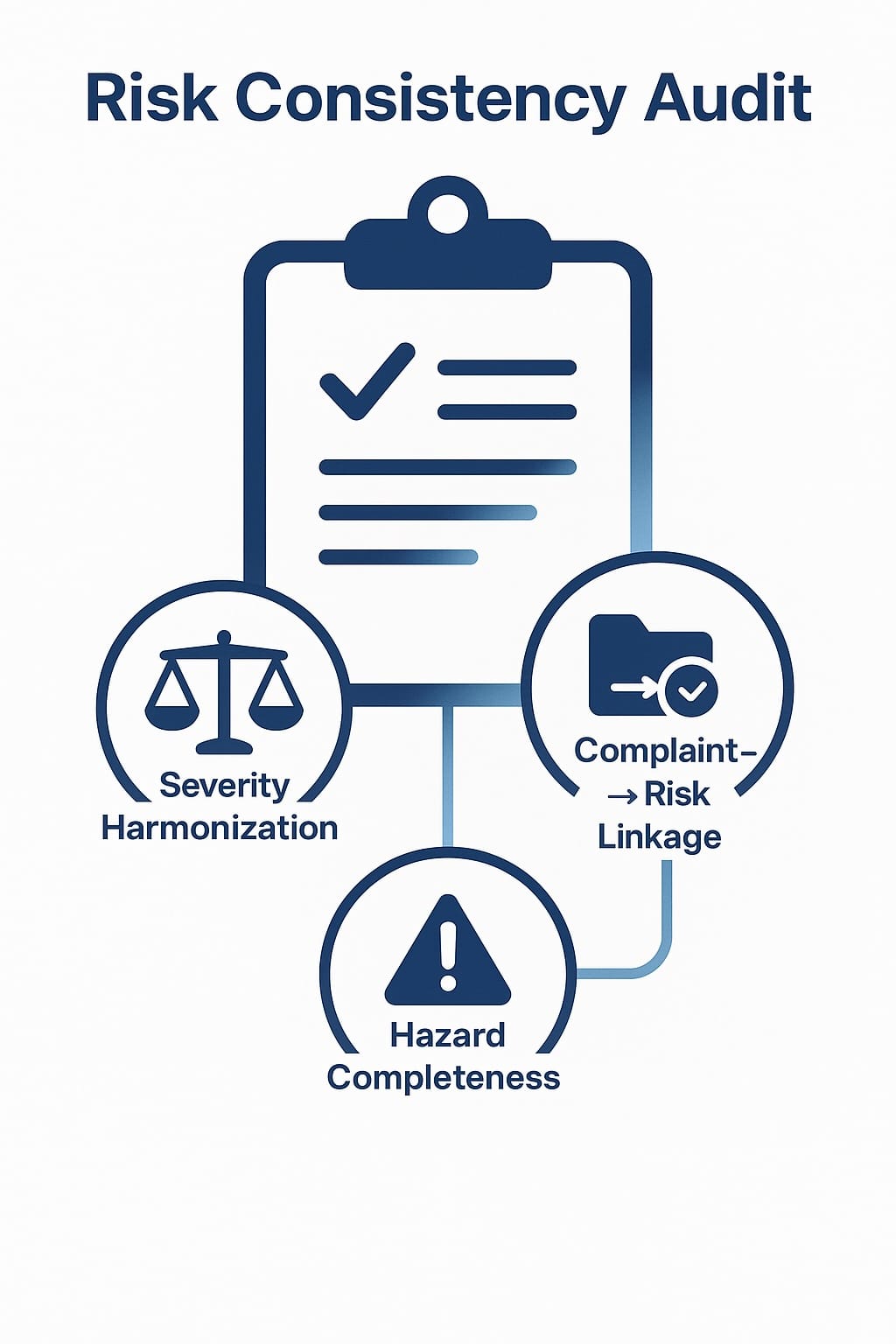
Don't wait for 2026. Conduct a "Consistency Audit" of your Risk Files today.
- Check your Severity Ratings: Does "Infection" have the same score in your Design FMEA, Process FMEA, and Use FMEA?
- Check your Hazards: Envoy failed to list "Endotoxins" as a hazard for a sterile implant.[1] Are you missing "known hazards" defined in ISO 14971?
- Link Complaints to Risk: Does every complaint investigation force a review of the Risk File?
In the QMSR Era: Compliance Isn't About Having the File. It's About Having the Logic.
Under QMSR, FDA auditors—increasingly utilizing risk-based auditing techniques—will not simply ask for your complaint log. They will ask:
"Show me your Risk File for Infection."
They will then thread that single topic through Design (Severity A vs B?), Production (Water/Air controls?), and Post-Market (Complaint investigations?). The inconsistencies found at Envoy would be cited as evidence that the entire Management System is ineffective.
Corporate Context: A Cautionary Tale
Envoy Medical's situation reflects a classic resource tension. In September 2025, the company eliminated over $32 million in debt to focus on its pivotal trial for the new Acclaim® cochlear implant.[2] Meanwhile, the "maintenance engine" for its legacy device (Esteem® II) stalled, leading to long-standing uninvestigated complaints.[1]
Takeaway: Strategic focus on R&D cannot come at the expense of post-market surveillance for legacy products.
Sources:
- FDA Warning Letter CMS # 718762 (Envoy Medical Inc., Nov 11, 2025)
- 21 CFR 820.30(g) – Design Validation
- ISO 13485:2016 – Clause 7.1 / 8.2
#QualityAssurance #MedTech #FDA #QMSR #RiskManagement #ISO13485 #EnvoyMedical #RegulatoryAffairs #CAPA